Its just a show, Truman
Peter weir, with Andrew Niccol’s idea, has trapped Truman Burbank in hyper-sterilized 1950s Americana, brightly coloured, where There is no crime, no mess and no unpredictable weather. The villain isn’t a dictator but a television producer who justifies the imprisonment by keeping Truman “safe.” It’s funny in two whole different levels – Jim carry IS hilarious as always, as Truman. But the funny part is the structural integrity of the film – an anaesthetic that lowers our defences. The original idea was to imprison Truman in a gloomy New York script. Peter Weir, saw the script as a masterpiece that it is, suggested a utopian world instead. And so it was, a true entertainment for millions, both in the show and in the real world. With plenty to say between Truman’s afternoons, evenings and nights.
As a comedy, it had wonderful moments: When we laugh at the slapstick rainstorm that only pours directly on Truman, or the two old ladies watching him sleep on their television, gradually becomes disturbing when it clashed in our day-to-day situations. The deeply uncomfortable moments belong to Truman’s “wife,” Meryl. Imagine having a complete existential breakdown, crying out that your reality is dissolving, and your spouse responds by hitting her mark and delivering a perfectly lit commercial pitch: “Why don’t you let me fix you some of this Mococoa drink? All natural cocoa beans from the upper slopes of Mount Nicaragua. No artificial sweeteners” (Burbank, M., The Truman Show, 1998). It is hilarious because of how unnatural it is, but it instantly turns terrifying. The comedy highlights the ultimate capitalist nightmare: human connection commodified.
Glitches in the Matrix The pacing of Truman’s unravelling is a masterclass in paranoia. The flow isn’t driven by an explosive hero’s journey; it is driven by sloppy production or just by fatigue of matter (of the projectors). A spotlight falls from the sky, literally shattering the heavens on the pavement. A car radio intercepts a backstage frequency. Truman’s drive to escape is sparked by the realization that his routine is a script. When he finally notices the loop—the lady on the red bike, the man with the flowers, the yellow Volkswagen—it plays out like a comedic sketch. He predicts their movements like a cynical orchestra conductor. For the sensitive, this punchline lands on the audience. How many of our own daily commutes look exactly like those looping extras?
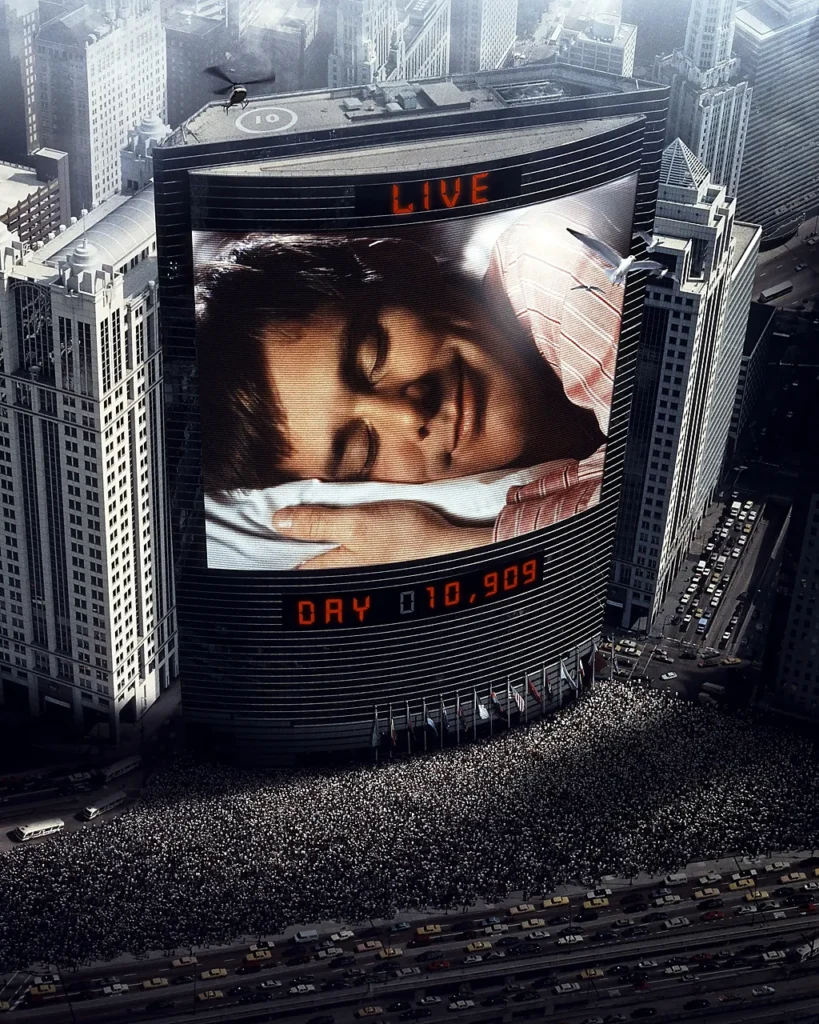
The Sound of the Hamster Wheel Underneath this manufactured reality is an auditory loop. The original score, heavily supplemented by Philip Glass, is built on minimalism – taking a musical phrase and repeating it endlessly. It is the literal auditory equivalent of a hamster wheel. When Truman goes through his programmed motions, the music is light, repetitive, and aggressively pleasant. But when he starts to break the script – aggressively driving over the bridge, running into revolving doors – the score turns frantic and discordant. The music is the sound of the control room panicking.
The Splinter in the Mind Before the spotlight fell, was Sylvia. She was the original glitch. When she dragged him out of the camera’s sightlines and frantically warned him, “Everybody’s pretending, Truman… It’s all for you” (Sylvia, The Truman Show, 1998), he looked at her like she was speaking a foreign language.
“We accept the reality of the world with which we’re presented. It’s as simple as that” (Christof, The Truman Show, 1998). So true.
He couldn’t understand her because the weight of that paradigm shift was too massive to process. To accept her words meant grieving his entire existence – accepting that his childhood was a lie and his friendships were commercial transactions. The system immediately gaslit him, providing a comfortable excuse by dragging her away and claiming she was schizophrenic. Sylvia however, didn’t give him a map out of Seahaven. she gave him a compass. For years, Truman hides her red sweater and obsessively reconstructs her face using magazine clippings. Everything else in his life was perfectly tailored, perfectly lit, and completely hollow. Sylvia was real. Her warning lay dormant like a virus until the system got sloppy enough for her “crazy” theory to become the only logical explanation left. She was the physical embodiment of undeniable drive.
Its just a show, Truman
We cannot talk about the cage without looking at the architect. The easy thing to do is call Christof a supervillain, but that misses the point. Christof is the ultimate helicopter parent armed with a billion-dollar broadcast budget. He doesn’t want to destroy Truman. he wants to curate him. As Christof defends his creation on live television, “I have given Truman the chance to lead a normal life. The world, the place you live in, is the sick place. Seahaven is the way the world should be” (Christof, The Truman Show, 1998). The desire to act as God rarely starts with malice. It starts with the urge to script reality rather than live it, to keep something perfectly predictable. Nonetheless, Christof couldn’t build a physical wall around Truman, so he built a psychological one. He traumatized Truman with water by “killing” his father in a boating accident. He engineered a phobia to keep the sheep in the pen. Truman’s curiosity nearly killed him. The climax of the film is Truman battling the artificial storm, screams at the painted sky, “Is that the best you can do? You’re gonna have to kill me!” (Burbank, T., The Truman Show, 1998).
Fun fact: This film arrived in 1998, exactly five minutes before the reality TV tsunami hit the shore. It didn’t parody a global obsession. it predicted one. When George Orwell wrote about a surveillance state, he envisioned a boot stamping on a human face. In his world, telescreens are mandatory, and “Big Brother is watching you” (Orwell, 1984, 1949) is a terrifying threat. But society took Orwell’s warning and turned it into a prime-time game show. The first massive reality hit literally named itself Big Brother. Apparently, it is much easier to control a population by entertaining them than by threatening them. Preferably, with manicured lawns and friendly neighbors, directed by Peter Wier.