Drive as a Measurable Factor
Vincent dreamt of touching the stars. The world told him no. Biology gave him a receipt for a life expiring at thirty, marked with a 99.9% probability of heart failure.
He cheated and went anyway.
Looking back, it is a story about the terrifying power of simple decisions and the invisible weight of human ambition.
Take the decision to conceive a child naturally. In Gattaca, a “faith birth” is reckless endangerment. But that single, fatal decision to be born “wrong” was the reason Vincent made it to space.
As Steve Jobs famously noted, “You can’t connect the dots looking forward; you can only connect them looking backward” (Jobs, 2005 Stanford Commencement Address). Looking back, Vincent’s “invalid” status wasn’t a bug; it was the feature. It gave him something his genetically flawless brother lacked: hunger.
To understand the trap, you have to look at Gattaca through its architect’s eyes. Director Andrew Niccol didn’t give us a shiny, laser-filled future. He gave us a retro-future that looks suspiciously like 1955. By dressing tomorrow in the clothes of the past, Niccol makes a chilling point: prejudice isn’t a futuristic concept; it’s an ancient human flaw wearing a sharper suit.
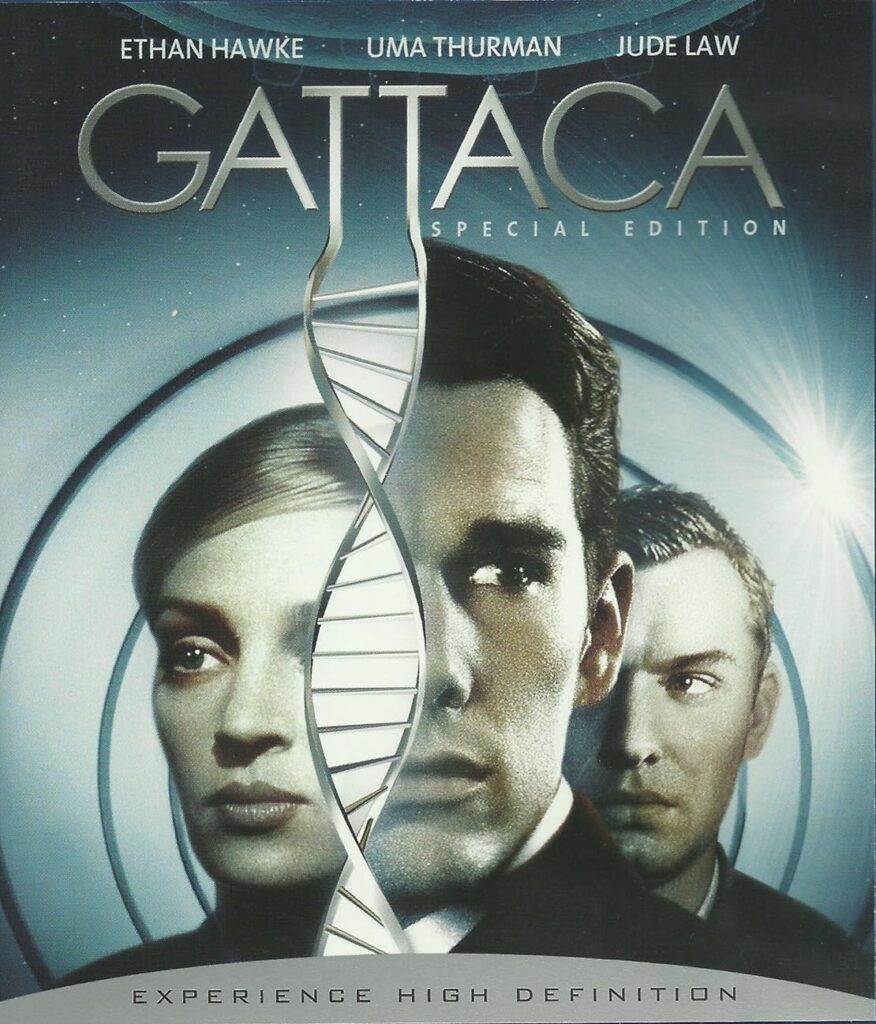
Niccol shoots the human body as if it is a crime scene. A falling eyelash, a flake of skin—under his paranoid, extreme close-ups, these are treated as felonies. And the most terrifying part? That discrimination is entirely HR-approved. True dystopia isn’t boots marching in the street; it is a quiet, air-conditioned room where a polite receptionist tells you your DNA doesn’t meet the company standard.
Niccol built a world obsessed with sterility—polished steel, symmetrical faces, filtered air. But the most honest moments in the film happen in the ocean.
The water is murky, chaotic, and full of sea grass. The “Valid” world tries to scrub away the messiness of life, but Vincent wins because he embraces the mess, right from birth. While his genetically perfect brother was saving energy for the swim back, Vincent was willing to drown.
“This is how I did it, Anton: I never saved anything for the swim back” (Gattaca, 1997).
Anton was the starter of Vincent’s engine. Jerome was the fuel.
Jerome had the perfect genes and the perfect legs; he could have gone to Titan. At dinner, Vincent points out that those legs are entirely useless in zero gravity. This exchange emphasizes two critical points:
Society was optimizing humans with blind parameters—discarding geniuses for flat feet, only to send them to a place where feet are just landing gear. They weren’t selecting for the mission; they were selecting for the poster.
Jerome’s spirit was crushed when he came in second best. He never had to fight to get a job, fight for a way of life, or fight to get what he wanted. He was society’s made man, with society’s manufactured dreams, and had no need to exert effort. Jerome was a prisoner of his own DNA. He lacked the drive.
As Jerome confesses to Vincent in the film’s final act, “I got the better end of the deal. I only lent you my body. You lent me your dream” (Gattaca, 1997). Perhaps, when Jerome climbs into that incinerator wearing his Silver Medal, he isn’t accepting defeat. He realizes that helping the impossible happen was a Gold Medal performance.
At that point, Michael Nyman’s sweeping, minimalist soundtrack becomes the beating heart of a completely sterile movie.
Underneath the swelling strings is a relentless, repetitive, driving rhythm—a steady pulse. It highlights the profound irony of the film: a movie about a man doomed by a “bad heart” is driven entirely by a soundtrack that refuses to skip a beat. When the characters are forced to be stoic, Nyman’s score is the only thing allowed to cry. It is the emotional release valve for a soul breaking free.
If drive and purpose were as “feelable” as temperature and as seeable as light, would we ignore them?
In our world, we obsess over what we can measure. We pursue these metrics with perseverance because they are easy and well-defined. But we ignore the “voltage” of the human spirit because we can’t see it on a thermometer.
If we could see ambition like a thermal heat map, Vincent wouldn’t have been an “Invalid.” He would have been blindingly bright. He was running high voltage in a blind society.